Your Breath On My Window
Seeing Your Breath on My Window
About Performance Art and Intimacy during the Pandemic
Lital Dotan interviewed by Eyal Perry (USA), as published in TURBA Vol 1 (2), 2022
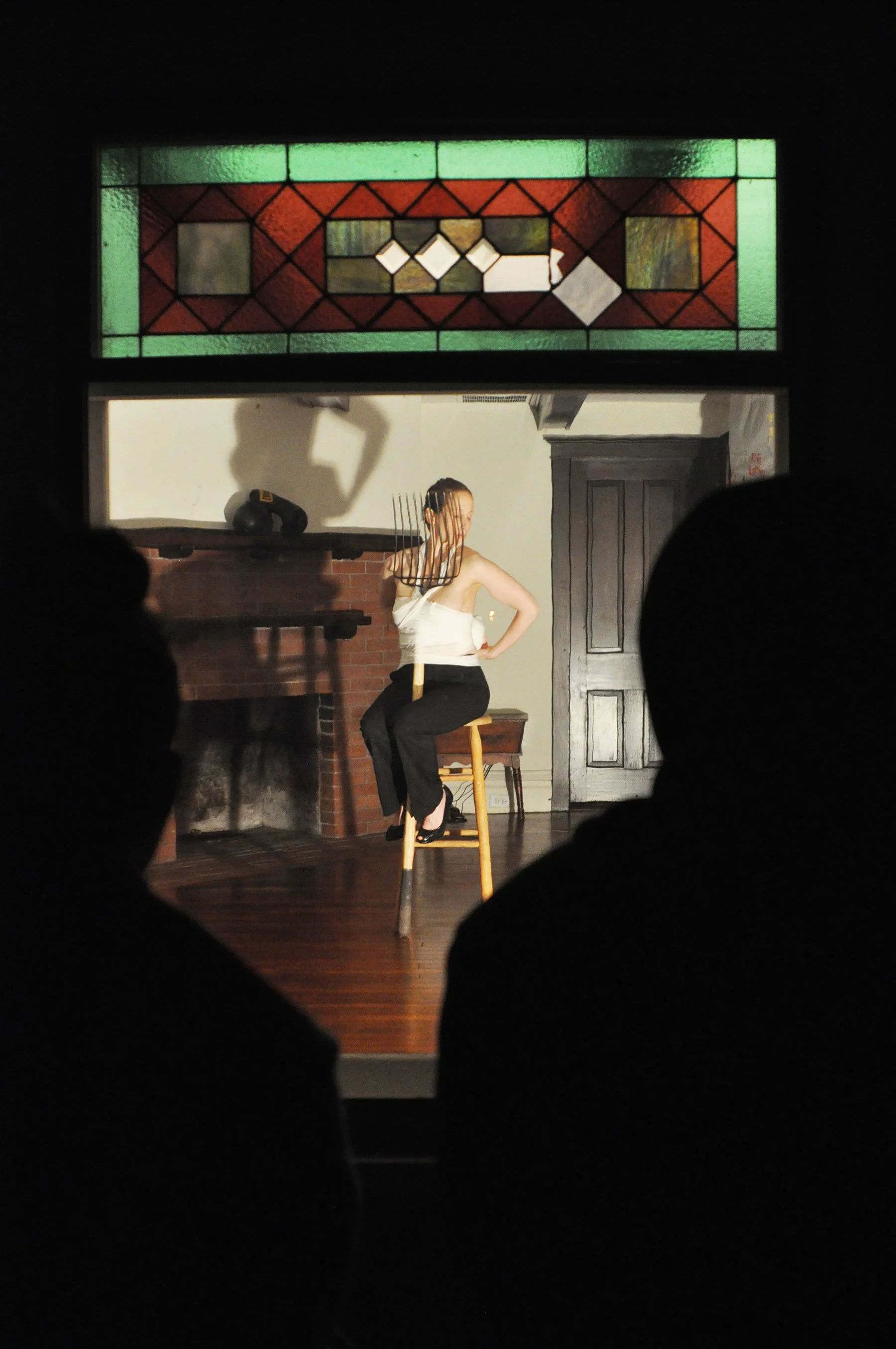
Lital Dotan, performing in Your Breath On My Window, 2020. Photo by Eyal Perry
Eyal Perry (EP): I have been your witness and the silent presence in your performances for more than twenty years now, yet when I witnessed and documented Your Breath on My Window, during the pandemic, something felt different. Standing distant, next to only one or two as your audience, watching you from outside, with a glass window separating us for the first time ever during a performance, made me wonder what were you fighting for as a performer. What was that urgent need you had to go through so much, just to perform in front of so few? What perspective on performance during the pandemic led you to create this series in particular?
Lital Dotan (LD): Yes, it felt so precious because we were all quarantining then. I didn’t see anyone for weeks. The necessity to socially distance was at its peak, so I developed this new format for performances called Your Breath on My Window, a series of window performances for a single household audience designed for the self-quarantined. We always left some wine outside on the porch for our guests as well, so it would feel like we were still hosting even though we couldn’t at first properly interact. It was shortly after our move upstate and we were eager to continue evolving our hosting practice as Glasshouse, which has been our art-life-lab for performance art continuously since 2007. Our twin girls were barely two years old then, and the late-night performances worked perfectly. This whole gesture was actually an evolution of the window performances I’ve been doing since 2010, but each version approached the window differently, serving up a different offering. This time the separation marked intimacy through generosity. Although a window separated us, I did feel the triumph of not giving up on being physically present, doing things in person as much as possible. I remember the conversation in those days was about going virtual and broadening programming through online engagement, and I just resisted this whole approach. It physically made me feel sick. So I came up with this concept, thinking, “I’d trade a million online views for seeing your breath on my window.” I’ve been window-performing every Thursday night until we were allowed to open the door and greet audiences.
The days were a bit chilly still. So out of consideration to guests, the performances weren’t long, around thirty to forty-five minutes, which is uncommon in my practice, which is usually more durational work. The piece I developed for this performance was part of my Embracement series. In it I hold a corsage of thistles and wrap my upper body in bandages, tightening the bandages around my body and with it the thistles as well, making as if one, the wound, the cause of the wound and the healing bandage. It is a work that confronts pain and the cause of pain and wraps them together, as in a never-ending tango. For this variation I used a pitchfork, which I understand now as a precursor to the racial injustice protests that would come next. It was before the racial reckoning in the United States following George Floyd’s murder, before we knew that the hardest hit communities by the pandemic would be Black, Latino, and Native American. It just became this symbol of an uprising waiting to happen.
EP: What came up frequently in our conversations during the pandemic was your pain, an evident emotional and intellectual pain from the shift that performance art took during the pandemic, a shift that felt like a defeat. At the same time, you had this clear conviction that you can help performance art survive the pandemic. Can you talk more about that?
LD: In the beginning I was worried about the effects social distancing would have on performance art on the long run. I’ll admit that seeing major institutions pivot to online programming was a scary moment. I was intentionally focused on ways in which performance art could overcome this too comfortable and not-so-challenging experience of seeing a performance without being present, without leaving one’s home. I wasn’t ready to separate the medium of the intimacy and intensity that are so embedded within it. A quote on my chalkboard wall from Jacques Rancière’s The Emancipated Spectator gave me an answer. It reminded me that performance art should not attempt to bypass the needs of physically present audiences. To put it in his words: “Evil consists in the separation between the stage and the audience, between performance of the bodies on stage and the passivity of the spectators” (2011: 62).
Separation is the enemy of performance, and I know it from my own brutal experiences, when performing my work Second Floor (2010), my first window performance. It was the last performance in a series of our works hosted at the Marina Abramovic Institute West as an experiment for a nomadic Glasshouse. The structure was different then. The performance took place in a building across from the institute, and the audience watched it through a second-floor window. We called it a “live movie” and the audience was asked to document it. What was supposed to be an invited aggressive intervention got out of control and I was brutally attacked by a participant in that performance while the audience was watching and documenting from that window across the street. None of them intervened. It was a complicated event that got out of control. I was left with physical and mental bruises and all the footage the audience took. I wrote a play, and we are now publishing a book about what happened that night. I still believe that what allowed this brutality was the separation.
EP: You have been curating our Glasshouse project for fifteen years now, and I wonder, in retrospect, how the pandemic and the unique circumstances of Glasshouse at that time influenced your curation? What were some new challenges or struggles you faced?
LD: Shortly before the pandemic, in 2019, the Glasshouse project moved from a Brooklyn storefront space (and our domestic art installation) into an 1850s former inn in New Paltz, a college town in a rural setting ninety minutes from New York City. Over the years, we had hosted artist residencies, festivals, exhibitions, and, especially in our Brooklyn days, felt part of a very dedicated performance community. The move upstate was bound to create a different setup, which I intentionally allowed time to shape. The theme for our reopening season in summer 2021 at Glasshouse Upstate was House Arrest, which partly hinted at the pandemic days of self-isolation and the heightened racial accountability conversation we finally started having in the United States. Yet the core motivation behind the theme of the program was to reflect on the idea of an archive in performance—the role of the home in the evolution of the archive (as Derrida reminded us at the very opening of Archive Fever in 1998), the performativity of the domestic archive, the shifting in showcasing what is intentionally archived and how life interferes and intertwines with the archive and its keepers. There is always a lingering question: what remains after a performance, who keeps the remains, how can these remains be displayed, and when do remains become something entirely new?
We finally opened our doors in the summer of 2021 after many months of conversations with our three artists in residence: Sindy Butz, Emilio Rojas, and Donna Kukama. The warmer weather and vaccinations made it feel almost natural to meet people after a long time apart. We hosted the artists in residence at our home; our girls were three then and too young to be vaccinated. So there was this gentle mutual accountability in protecting each other—committing to the work and doing our best to remain cautious. It worked. For the first performance, many guests traveled from New York City, but since commuting had become a lot more complicated during the pandemic with mask mandates and fewer buses, we intentionally focused on bringing in the local Hudson Valley community. In general, I do feel that the turbulent time made many of us better people—more generous, more accountable, and more accepting—and I really hope that at least this aspect will remain.
EP: When we moved Glasshouse, and with it our lives, out of New York City, we faced the unknown, and we needed a leap of faith that your art and Glasshouse will still be significant outside the big city. What was the transition like for you? How do you feel now about building a performance art community and space from scratch?
LD: I must say that the transition went surprisingly well and so far has really exceeded our expectations because of the amazing local community that is so fascinating and open to the experimental work we present. There are several performance venues around us, such as the Rosekill Art Farm in Rosendale and the Art/Life Institute of Kingston. The Carolee Schneemann Foundation is just up the road from us, and we have all been collaborating quite frequently. The more we research, the more exciting artists we find living nearby. We are indeed far from our more natural urban community, but I see so much potential in the sensibilities that this nature-saturated environment brings. There is room for more people, more collaborations. It just feels much more inclusive and open-ended. Who says quality performance work needs an urban setting? If there was any fear initially that we would be left outside of the art conversation, I feel no compromise now. It really feels that we are finally building something together, maybe a place for performance art in history.
EP: The pandemic created a completely new setup of a daily routine for you. With the girls at home 24-7 for a year and a half and an isolation that is so much in contrast to performance art, I sense that your reality was framed by a “psychological time” that created new challenges as well as opportunities for your artistic practice. What new art and approach emerged from the battlefield of the pandemic?
LD: Between motherhood, work, curation for Glasshouse, and my own artwork, I was juggling many worlds even before the pandemic. Self-quarantining allowed me to reclaim time, not just in the sense of productivity but as a sensation of passing time. What helped me at first was focusing on my daily routine, which is performative by nature and a major part of my artistic practice over the past decade. It gave a rhythm to the everyday and helped me tune into a different creative process which was awaiting an audience. Instead of working on the production of my play, which was scheduled for a full run at an off-off Broadway theater in New York, I found myself writing a new play about a postpartum mother during the quarantine who is struggling to maintain a performance practice through poverty, isolation, and loss. Another aspect that broadened when social interactions were limited were my performance sculptures; I completed a series of plexiglass sculptures called Specific Gestures (2020), which offered intimate gestures in a time of pandemic. Each was based on my long-lasting one-to-one performance practice in which I offer a performance for a single audience member—sharing a bowl of soup, hugging, sharing a bed with a stranger. The pandemic allowed me to consider the disappearance of intimacy and the way clear acrylic surfaces can shape interactions.
EP: In your artistic career, art and curation not only coexist but seem to be in a constant mutual influence on one another. I wonder, from your unique standpoint, what is your perspective as an artist on curation in a post-pandemic world? Do you think there would be a long-lasting change coming from it?
LD: Well, as an artist who primarily works outside the mainstream art channels, I do sense a humbled, more inclusive tone in some major curatorial projects now. Maybe it’s a shift from genius communication to one that is more human and community-centric, but it is too soon to tell. I see performance art as establishing a more stable ground in American culture, both as a vehicle for socially engaged art and in more traditional art settings across academic and museum institutions, because the world has changed, and historically, performance art was one of the first mediums to respond to change. It can be a powerful and empowering vehicle for many ideas relevant to real-world events. I strongly believe there is a big potential for the medium in this turbulence, both as an instrument for healing and as a placemaker in history that could de-marginalize artistic voices in the broader historical context. Fundamentally, I believe performance art is there to remind us what it feels like to be human.
-
Lital Dotan is a performance artist and curator based in New York. Her works are exhibited internationally in venues such as the Israel Museum, the National Museum in Krakow, the Queens Museum, and the Kitchen in New York. She has written several stage plays and is the subject of two monographs. She is the cofounder of the Glasshouse in New York.
Eyal Perry is an artist, educator, and collector of historical cultural artifacts. He teaches photography, photo-therapy, and socially engaged art. He is a cofounder and the archivist of the Glasshouse in New York.